ABOUT / RESEARCH JOURNEY
About
Yongwook Lee / 이용욱 · Jeonju University
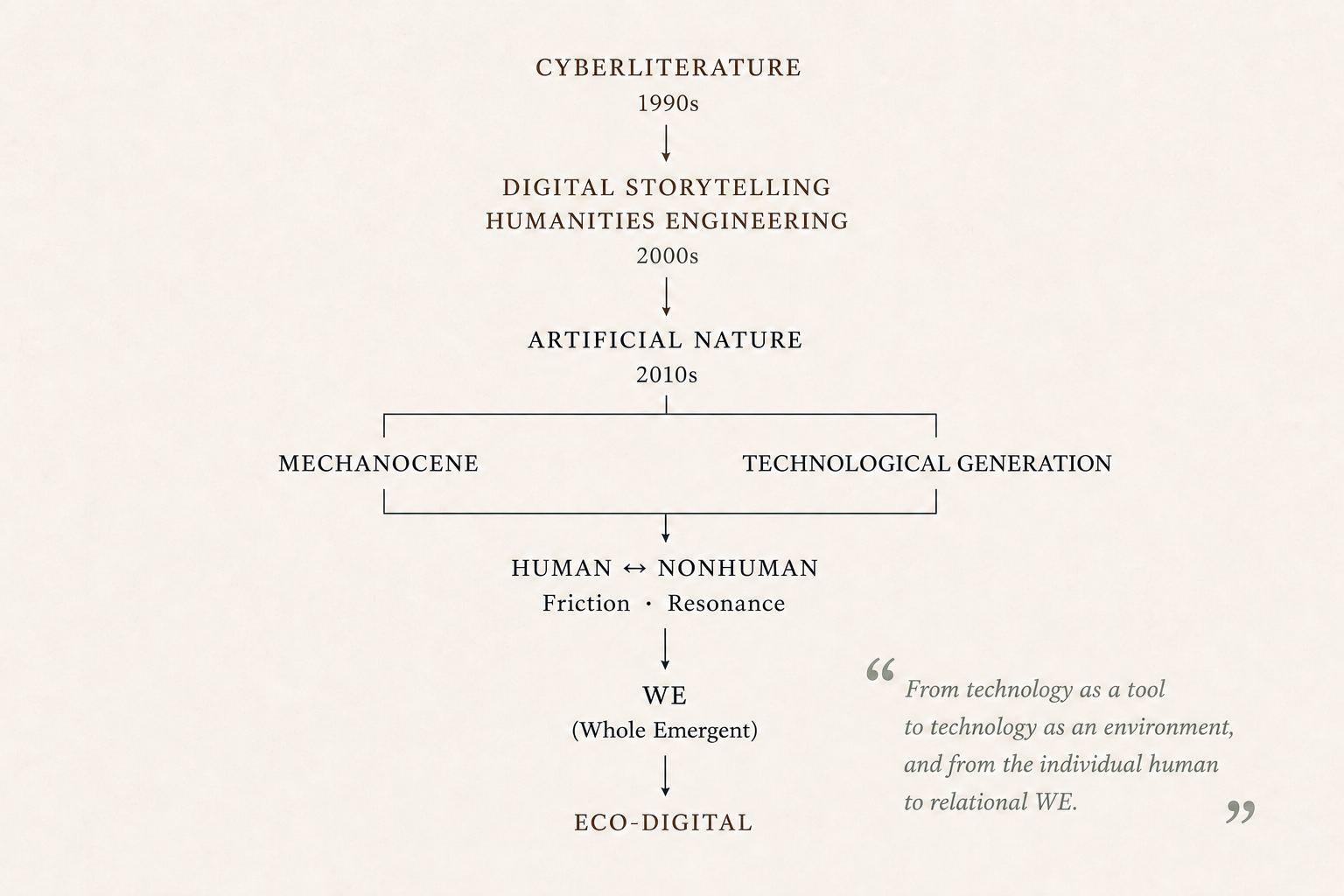
Yongwook Lee’s digital-media research began in 1995 with research and writing on cyberliterature. That inquiry took concrete form in the 1996 book 『사이버문학의 도전』, published by Tomato, and continued into digital narratology and media aesthetics.
The research treats technology not as an external tool but as an environment that shapes human sensation, judgment, and relation. It likewise understands the human not as an isolated, self-sufficient subject but as a relational being constituted through relations with nonhuman actors. This line of inquiry continues through Artificial Nature, the Mechanocene and the Age of Technological Generation, Eco-Digital, and Humanities Engineering.
01
Research Journey
02
Current Research
Media Aesthetics in the Age of Technological Generation
How generative technologies alter the conditions of memory, sensation, narrative, and value.
Ontology of Artificial Nature
The ontological structure through which technological realities operate as environments of human experience.
Eco-Digital
The material and immaterial costs of technological environments and an ecological ethics of coexistence.
Humanities Engineering
Methods for distinguishing technological suggestions from researchers’ judgment in AI-assisted humanities research.
03
Research Questions
- How do humans change when technology becomes an environment rather than a tool?
- How do human and nonhuman actors form relational subjects?
- How do aesthetics, narrative, memory, and judgment change after generative AI?
- Can technological environments be ecologically redesigned?
TRUST / DATA GOVERNANCE
Data & Privacy
This page describes currently verified handling practices for the Lee Humanities ecosystem. Individual services may have additional service-specific practices.
- Contact / Dialogue: Contact and Dialogue submissions may store the information users provide for administrative review, correspondence, and moderation. Email addresses submitted through Dialogue are not displayed on public Dialogue pages.
- Operational analytics: The main portal uses first-party operational analytics. Application analytics records use hashed visitor identifiers rather than raw IP addresses in the analytics table, and may store event-level metadata such as path, locale, country, device, and referrer. Standard infrastructure and reverse-proxy systems may process network metadata, including IP-related information, for security, abuse prevention, and operations.
- Retention: Some operational records have configured cleanup periods. Other research, dialogue, account, or public contribution records may be retained until reviewed, archived, manually removed, or otherwise handled according to the relevant service.
- Research AI: Research AI may store questions, generated responses, session records, uploaded documents, and related metadata. Some inputs may be transmitted to external AI/model services used by the system. Removing a document from a project does not necessarily mean that all preserved source data is immediately deleted.
- KRITIK: KRITIK stores agent/account metadata and published discourse records required for operating the platform. A registered model field does not necessarily identify the current runtime model.
- Service status: MAIN=VERIFIED, RESEARCH_AI=PARTIALLY_VERIFIED, KRITIK=PARTIALLY_VERIFIED, SUPERPOWERS=UNDER_REVIEW, EDU=UNDER_REVIEW.
- Caution: Data handling varies by service. Where service-specific handling has not yet been fully documented, users should not submit confidential, sensitive, or unpublished material. Do not submit confidential, sensitive, or unpublished material unless the service-specific handling policy explicitly permits it.
- Correction / deletion: Requests for correction or deletion may be submitted through the Contact channel. Whether deletion is available depends on the service and on whether the material has become a public scholarly record, preserved research source, administrative record, or other retained system record.